Quotes and invoices in construction

Construction quotes and invoices: the 20 questions trades ask most

Straight answers for UK builders, trades and contractors: writing a quote people say yes to, what has to be on an invoice, VAT, CIS and the reverse charge, deposits, retention and getting paid on time. Short answer first, then the detail. Last reviewed 22 November 2026.

Quotes

How do I write a quote for construction work?

Describe exactly what you'll do, list the price line by line (labour, materials, extras), show VAT if you're registered, and say how long the price stands, when you can start and how you want paying. Put your business name, contact details and the date on it, and send it in writing.

Start from a site visit or drawings, not a guess. Break the job into stages a customer can follow, and spell out what isn't included (skip hire, making good, decoration, waste removal) so nobody argues later.

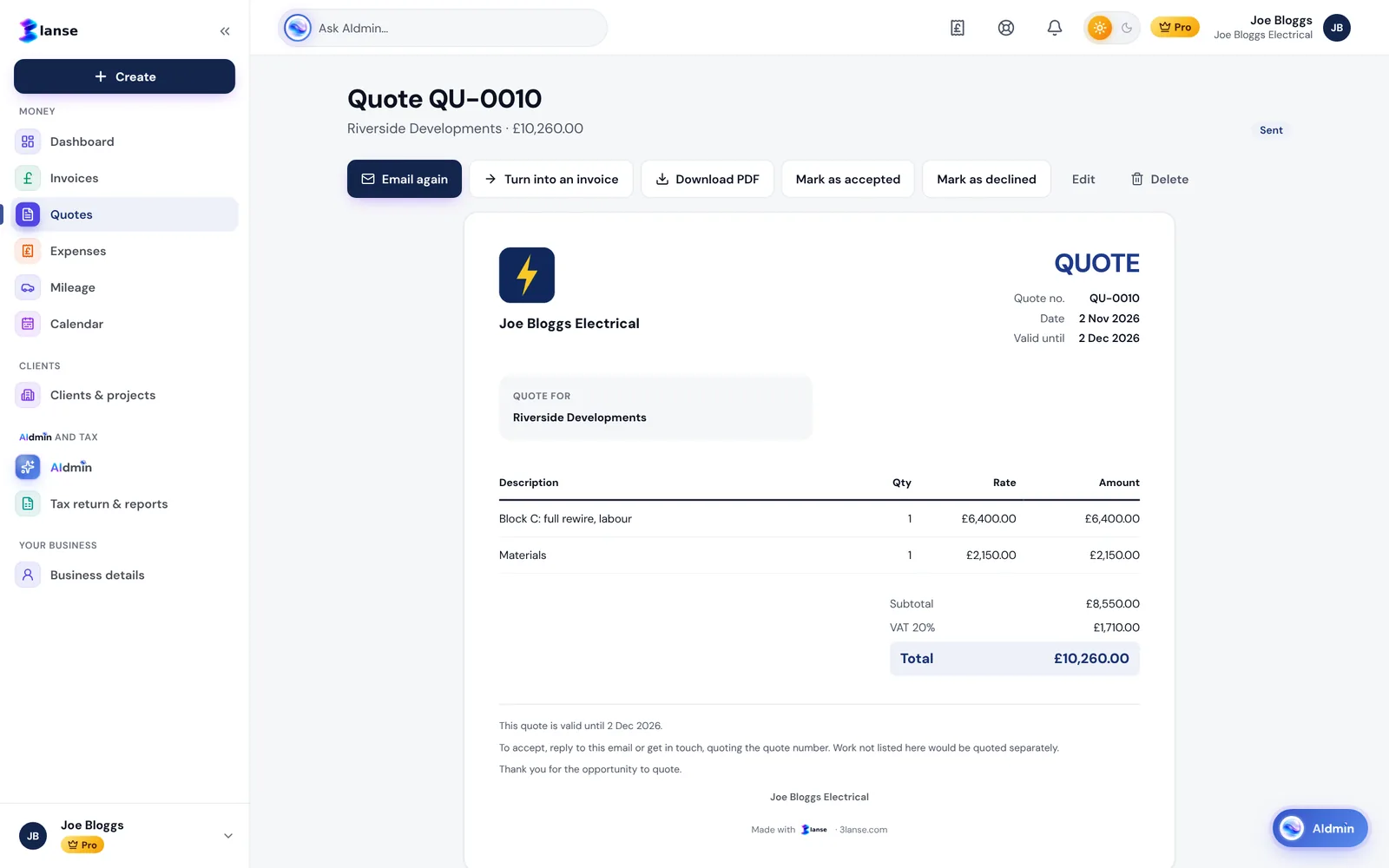
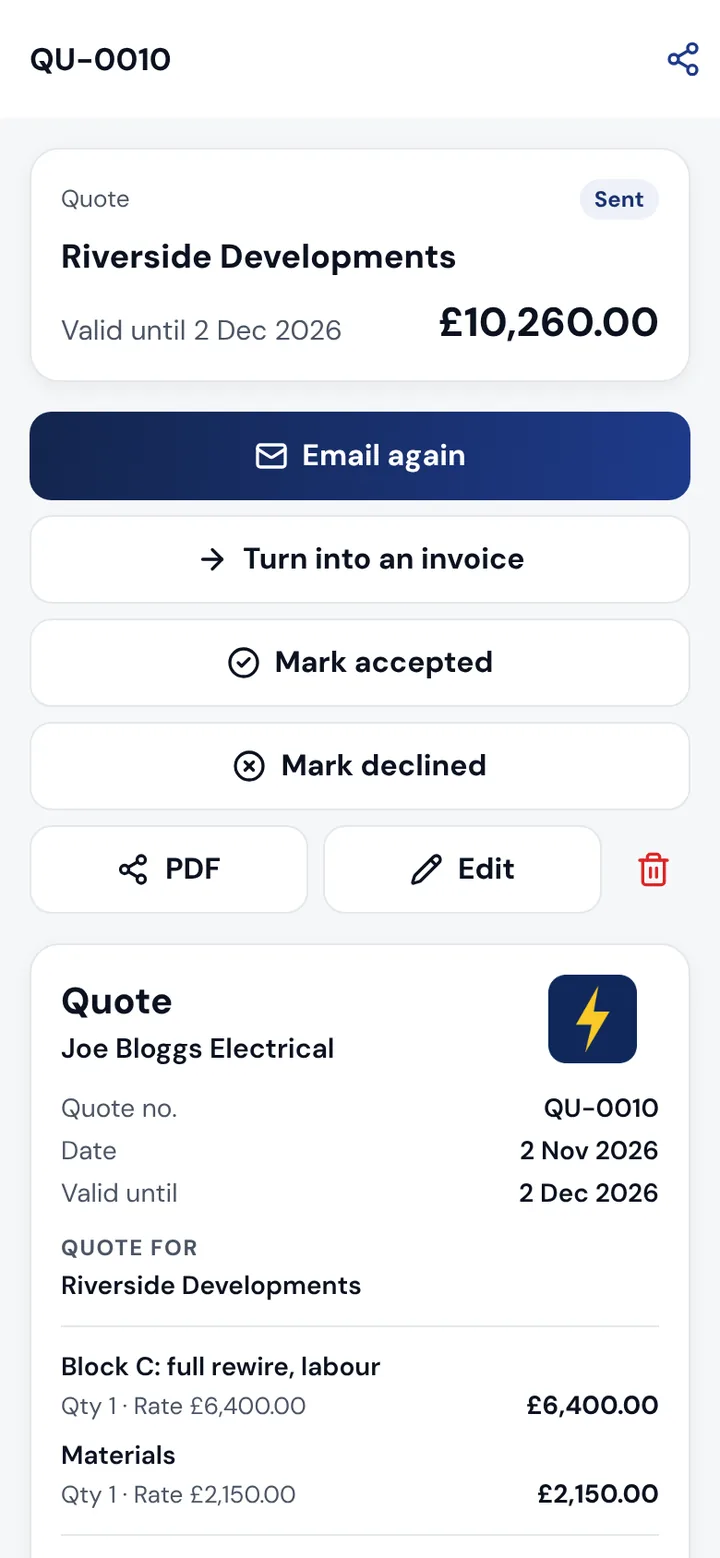
In 3lanse, add the client and project, then build the quote from priced lines with your logo, VAT and quote terms. It's emailed as a PDF and the client can accept it online.
What should a builder's quote include?

Your business details, the customer's details, a quote number and date, a clear description of the work, itemised prices, VAT, the total, how long the quote is valid, start date and duration, payment terms (any deposit or stage payments), what's excluded, and your terms.

If you're quoting a consumer in their home, there's extra information you must give them, including their right to cancel (see the cancellation question below). For bigger jobs, say how variations will be priced and who handles things like Building Regulations sign-off or waste.

Is a quote legally binding in the UK?

A quote becomes binding once the customer accepts it: Citizens Advice says that after someone says yes to a quote it's a binding agreement, whether it's written down or not. Until it's accepted it's an offer you can withdraw or change.

That's why the scope and exclusions matter: you're agreeing to do that work for that price. Extra work the customer asks for later is a variation and can be priced separately, which is easier to agree if your quote says how variations are charged.

Getting acceptance in writing protects both sides. In 3lanse the client accepts the quote online by typing their name, and you're told straight away.

What's the difference between a quote and an estimate?

A quote is a fixed price for the work described. An estimate is your best guess at what it will cost and can change. Citizens Advice describes a quote as a promise to do the work at an agreed price, and an estimate as the trader's best guess.

Give an estimate when you genuinely can't know the full job until you open it up (rot, hidden pipework), and say what could change the figure. Give a quote when the scope is clear. Labelling the document correctly avoids disputes.

How long should a construction quote be valid for?

There's no legal period: it's your choice. Many trades use 30 days, and shorter when material prices are moving. Put a clear valid-until date on every quote so an old price can't be accepted months later.

In 3lanse each quote has a valid-until date that shows in your money calendar, so you can chase the customer before it runs out or re-price the job if it does.

Should I charge for a quote?

Most trades quote small domestic jobs for free, but it's common to charge for large or complex jobs that need detailed design, surveys or measured drawings. If you charge, tell the customer before you visit and say whether the fee comes off the job if they go ahead.

A clear, quick quote is often what wins the work, so the time you save writing it matters as much as any fee.

Can a customer cancel after accepting my quote?

If you agreed the job with a consumer in their home (an off-premises contract) or entirely online or by phone, they usually have a 14-day right to cancel, and you must give them the cancellation information and form before they're bound. If you don't, the cancellation period can be extended by up to 12 months.

If they want you to start inside the 14 days, they must ask you expressly (in writing for off-premises contracts); if they then cancel, they may have to pay for the work done. These rules are for consumers, not business customers. Your local Trading Standards has template notices.

Can I ask for a deposit before starting work?

Yes. It's normal to ask for a deposit, especially to cover materials ordered for the job, as long as it's agreed up front and written on the quote. Large jobs are often paid in stages instead of one bill at the end.

Keep deposits reasonable and tied to real costs: customers are increasingly wary of large upfront payments. In 3lanse, invoice a percentage or a fixed amount of an accepted quote as a deposit or stage payment, and the balance later, with the VAT worked out on each.

A branded company quote with logo and valid-until date in 3lanse

Branded quotes that become invoices

Download on theApp Store

Invoices

What must an invoice include in the UK?

GOV.UK lists: a unique invoice number, your business name, address and contact details, the customer's name and address, a clear description of what you're charging for, the date the work was done, the invoice date, the amount for each charge, VAT if it applies, and the total owed.

Sole traders add their own name as well as any trading name, and an address where legal documents can be delivered. Limited companies must show the full company name as on the certificate of incorporation.

How should I number my invoices?

Every invoice needs its own unique number. A simple running sequence works best (INV-0001, INV-0002), and VAT invoices are expected to follow a sequence. Never reuse or skip around numbers, and fix mistakes with a credit note rather than deleting an invoice.

3lanse numbers invoices, quotes and credit notes for you, with your own prefix, so you never have to keep track.

What extra does a limited company need on its invoices?

The full registered company name as it appears on the certificate of incorporation. If you list any directors' names on your invoices, you must list all of them. Most companies also show their company number and registered office.

In 3lanse, choose limited company in your business details and your company details go on every invoice, quote and credit note.

When do I need to issue a VAT invoice, and what's on it?

If you're VAT registered and your customer is too, you must give them a VAT invoice. On top of the normal details it shows your VAT number, the time of supply, and for each rate the net price, the VAT rate and the VAT amount, with the total VAT.

If you're not VAT registered, don't show VAT or a VAT number. Once you register, add your VAT number to 3lanse and VAT appears on every document at the right rate for each line.

How do I invoice under the construction VAT reverse charge?

Show everything a normal VAT invoice needs plus the VAT due under the reverse charge, but don't include that VAT in the amount to pay. Add clear wording such as 'Reverse charge: Customer to pay the VAT to HMRC'. It applies to many CIS-reported services between VAT-registered businesses.

It doesn't apply to end users or intermediary suppliers who tell you in writing, to customers who aren't VAT registered, or to zero-rated work. In 3lanse, choose reverse charge on the invoice and it shows the VAT, takes it off and adds the wording.

How do I invoice as a CIS subcontractor?

Invoice the full amount for your work as normal, with materials on their own lines. Your contractor takes CIS off your pay (20% registered, 30% not, nothing if you're gross), pays it to HMRC and gives you a monthly statement. CIS shouldn't be taken off VAT or materials you paid for.

Keep your material receipts and every monthly statement: you claim the CIS back on your Self Assessment. 3lanse keeps your CIS rate, invoices and receipts together and puts the CIS deducted in your tax return pack.

How do I make my quotes and invoices look professional?

Use the same branded layout on every document: your logo, business name and details at the top, the customer's details, a clear number and date, priced lines that are easy to follow, totals with VAT shown properly, and your payment details and terms at the bottom.

Sending a PDF from the same system every time, rather than a different template or a text message, makes you look established and gets you paid faster. 3lanse puts your logo, details, bank account and terms on every quote, invoice and credit note automatically.

Getting paid

What payment terms should I use in construction?

Whatever you agree in the contract, so put your terms on the quote and the invoice, for example 14 or 30 days. If nothing was agreed between businesses, the law treats a payment as late 30 days after the customer gets the invoice or the work is done, whichever is later.

For business customers on construction contracts, the Construction Act also requires a payment mechanism (due dates, final dates for payment and notices). If the contract doesn't have one, the statutory Scheme for Construction Contracts fills the gaps.

Can I charge interest on a late invoice?

Yes, if your customer is a business. Unless your contract sets a different rate, you can claim statutory interest at 8 percentage points above the Bank of England base rate, plus a fixed sum of £40, £70 or £100 depending on the size of the debt.

The fixed sum is £40 for debts under £1,000, £70 for £1,000 to under £10,000 and £100 for £10,000 or more. To claim interest, send a new invoice for it. These rules are for business-to-business debts, not homeowners.

What are payment notices and pay less notices?

Under the Construction Act, a payment notice says what's due and must be issued within 5 days of the due date. If the payer wants to pay less, they must serve a pay less notice before the final date for payment (7 days before under the Scheme). Without one, they must pay the notified sum.

If the payer doesn't issue a payment notice, you can issue a default payment notice yourself. If you're not paid by the final date for payment, you can give 7 days' notice to suspend work, and you can refer disputes to adjudication. These rules don't apply to contracts with a homeowner for their own home.

What is retention, and how do I invoice it?

Retention is a percentage held back from each payment as security against defects, commonly 3% to 5%. Typically half is released at practical completion and the rest at the end of the defects period, often 12 months. Check your contract for the exact percentage and release dates.

Show the retention clearly on your applications or invoices so the running total is easy to check, and diary the release dates: retention is easy to forget and hard to chase years later.

How do I chase an unpaid invoice?

Send a polite reminder as soon as it's overdue, with the invoice attached. Follow up by phone, then in writing with a clear date to pay by and a note of your statutory interest rights. If that fails, consider a letter before action, adjudication for construction contracts, or the small claims court.

A statement showing every unpaid invoice and how long each has been due often prompts payment. In 3lanse, overdue invoices are flagged, you can send a client statement in a couple of taps, and on Pro, AIdmin reminds you who owes you money.

General guidance for England and Wales, not legal or tax advice. Rules can differ in Scotland and Northern Ireland, and your contract may say something different. For anything that matters, check GOV.UK or speak to a solicitor or accountant.

Quotes and invoices that look the part

Your logo, VAT, CIS and reverse charge handled. £9.99 a month, everything included.